
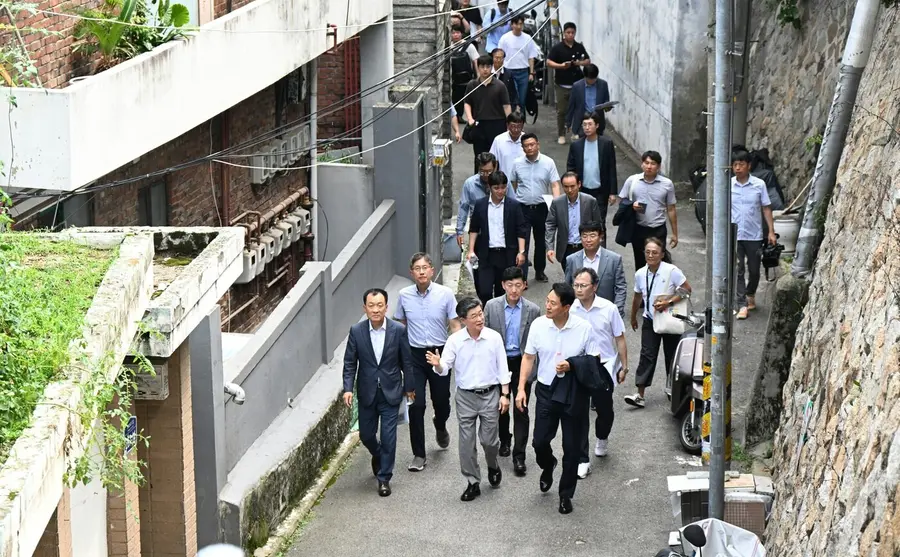
Among the 10 Seoul redevelopment project areas scheduled for relocation this year, 9 are experiencing difficulties in securing relocation funds due to government loan regulations. As a result, there are growing concerns that the supply schedule for approximately 31,000 housing units may be disrupted.
On the 27th, the Seoul City government held a briefing and revealed that, based on an investigation of 43 redevelopment project sites conducted over the past seven months since July of last year, 39 sites, or 91%, are facing challenges in securing relocation funds due to the government's loan regulation policies.
The government has applied regulations to relocation loans for redevelopment projects, including a loan-to-value ratio (LTV) of 40% for single homeowners, 0% for multiple homeowners, and a loan limit of 600 million won, following the measures to strengthen household debt management on June 27 and the housing market stabilization measures on October 15. Consequently, most project sites, except for three that completed management disposal approval before the enforcement date and one Moa Housing project that received approval for relocation loans from the Korea Housing Guarantee Corporation (HUG), are affected by these regulations.
Among the 39 regulated sites, 24 are redevelopment and reconstruction projects (approximately 26,000 units), while 15 are small-scale housing maintenance projects such as Moa Housing (approximately 4,000 units). These project sites are considering additional loans through construction company guarantees due to a lack of relocation funds, but they are inevitably facing interest burdens due to high interest rates.
Funding conditions show a clear polarization depending on the project size and construction company. Large-scale redevelopment projects in areas like Gangnam can secure additional funding at interest rates 1 to 2 percentage points higher than the basic relocation funds, while small and medium-sized projects must endure interest rates that are 3 to 4 percentage points higher.
In particular, small-scale maintenance projects such as Moa Housing, which involve mid-sized construction companies, are at risk of project delays or halts during the relocation phase. In a Moa Town area in Myeonmok-dong, Jungnang-gu, many members of the association fall under the loan regulation category, and the construction company has refused to provide guarantees, causing difficulties in project advancement.
The Seoul City government pointed out that this situation is leading not only to increased financial burdens for association members but also to project delays and rising project costs. In fact, among the 35 sites facing difficulties in securing relocation funds, only 8 are capable of obtaining additional relocation funds, while 27 are reported to have uncertain or impossible funding prospects.
In response, on the 22nd, the Seoul City government requested the Ministry of Land, Infrastructure and Transport to reasonably adjust regulations, such as applying an LTV of 70% by separating relocation loans from general mortgage loans. They also conveyed the damage status of 40 redevelopment project sites affected by loan regulations to the Ministry of Land.
Choi Jin-seok, head of the Housing Division of Seoul City, stated, "Relocation loans are not just simple household loans but essential project costs for housing supply," and emphasized, "We must urgently shift the policy paradigm to ensure that the scheduled housing supply timeline is not disrupted."
댓글 (0)
댓글 작성
댓글을 작성하려면 로그인이 필요합니다.
로그인하기