
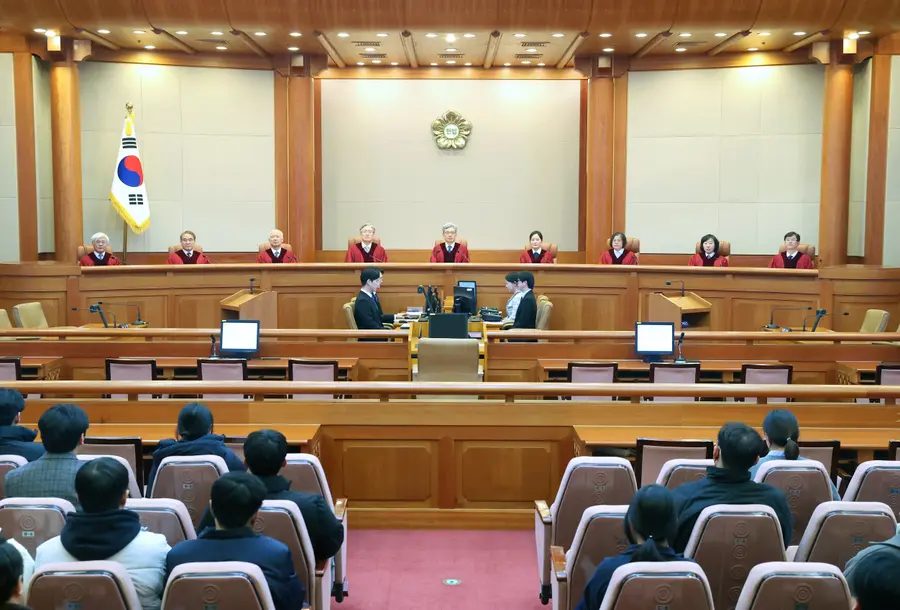
The Constitutional Court has ruled that the "3% threshold clause" applied as a criterion for the allocation of proportional representation seats in National Assembly elections is unconstitutional. The constitution has raised issues with the institutional barriers that have blocked the entry of minor parties into the National Assembly. However, it has been pointed out that even if the legal threshold clause disappears in local council elections, the number of proportional representation seats is so low that the "natural threshold clause" remains a significant barrier.
On the 29th, the Constitutional Court ruled the first paragraph of Article 189 of the Public Official Election Act unconstitutional with a 7 to 2 opinion. The court stated, "It is a significantly irrational legislation that infringes on the freedom to establish political parties, the right to vote, and the right to equality, and obstructs the reflection of diverse public opinion." This clause stipulates that only parties that receive more than 3% of the votes in proportional representation elections or obtain more than 5 seats in district elections are allocated proportional seats.
There are analyses suggesting that if this decision had been retroactively applied to the 22nd General Election, the results would have been different. The Liberty Unification Party, which recorded a proportional representation vote rate of 2.26%, and the Green Justice Party, which recorded 2.14%, were pushed out of the National Assembly due to the 3% threshold clause, but without the threshold clause, they could have secured at least one seat by surpassing the natural entry barrier (approximately 2.17%) based on the 46 proportional representation seats in the National Assembly.
Minor parties have immediately demanded the abolition of the "5% threshold clause" that also applies to local elections. They argue that the threshold clause, which requires a higher vote rate than that of the National Assembly, is a typical toxic clause that undermines the diversity of grassroots democracy.
However, there is also a strong counterargument that removing the legal threshold clause does not necessarily lower the entry barriers for local councils. This is because the number of proportional representation seats is extremely low, and the "natural threshold clause" continues to operate.
In the case of Incheon City Council, there are only 4 proportional representation seats out of a total of 40. Even with simple calculations, 25% of valid votes are needed to obtain one seat. Considering the reality that the two major parties take most of the votes, a party would need to secure at least 10-15% of the votes to expect to receive any remaining seats. In this structure, even if the 5% threshold clause is abolished, the practical change is limited.
The situation is not much different in the Gyeonggi Provincial Council, the largest in the country. The Gyeonggi Provincial Council elects 15 proportional representation seats, and in this case, the natural threshold clause reaches about 6.7%. Even if the 5% threshold clause disappears, minor parties that receive 5-6% of the votes still find it difficult to secure seats.
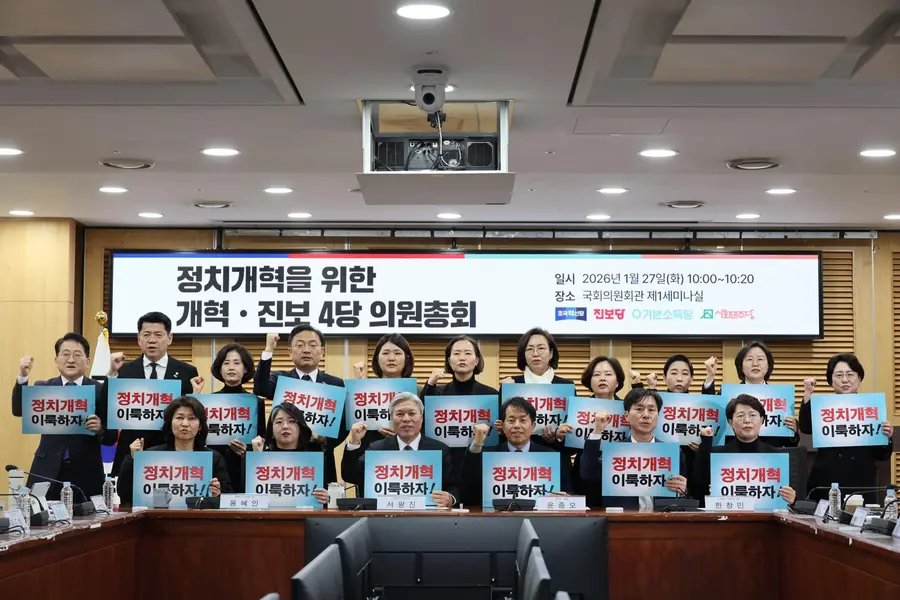
For this reason, there are concerns that without a structural overhaul of the electoral system, the abolition of the threshold clause may only serve as a "false hope." Justice Reform Party member Jeong Chun-seng proposed expanding the proportion of proportional representation in the provincial council to over 30% through amendments to the Jeju Special Law. The idea is to first strengthen proportionality in Jeju, a special self-governing province, and then expand it nationwide.
If this plan is applied to the Incheon City Council, the number of proportional seats would increase to around 12, and the natural entry barrier would be lowered to about 7-8%. If the proposal to increase the number of members under discussion in the Special Committee on Political Reform (46 seats) is applied, the number of proportional seats could increase to a maximum of 14.
Democratic Party member Lim Mi-ae suggested the introduction of a large electoral district system and a regional proportional representation system as alternatives. Member Lim argued, "The basic council should fully adopt the large electoral district system, which elects 3-5 members, to reduce wasted votes, and the regional council should break the monopoly structure of the two major parties with a regional proportional representation system."
The Constitutional Court judged that the possibility of parliamentary functions being paralyzed due to the abolition of the threshold clause is not high. They also cited that, in South Korea, a presidential system country, the formation of a majority force within the parliament is not an absolutely necessary structure like in parliamentary system countries. Considering that the proportion of proportional representation is only 46 out of 300 members of the National Assembly (15.3%), it is explained that even if the threshold clause is removed, the number of parties entering the National Assembly will not increase significantly.
However, some justices expressed concerns about the possibility of extremist forces entering the National Assembly and voiced dissenting opinions. Nevertheless, the majority opinion of the Constitutional Court concluded that "in the political reality where the two major party system has solidified, the threshold clause has functioned to block the entry of new political forces rather than ensuring parliamentary stability."
Ultimately, the Constitutional Court's judgment revealed the reality that simply removing the legal barrier of the threshold clause makes it difficult to achieve political diversity. There are calls for fundamental electoral reform discussions that include expanding proportional representation and restructuring the electoral system.
댓글 (0)
댓글 작성
댓글을 작성하려면 로그인이 필요합니다.
로그인하기