
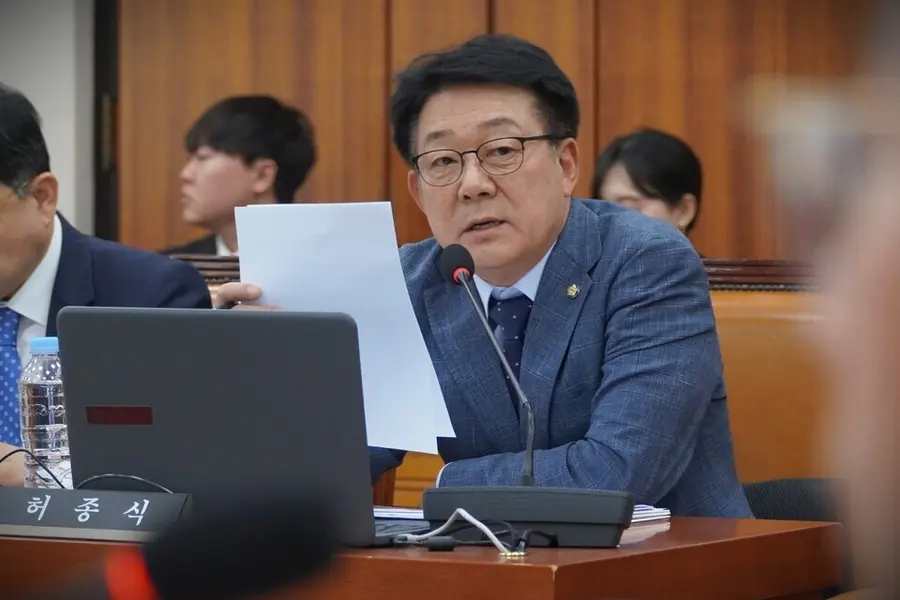
A bill to prevent the reduction of basic council members for the Incheon Jemulpo District, which is scheduled to launch in July 2026, has been submitted to the National Assembly. Heo Jong-sik, a member of the Democratic Party (Incheon Dong-gu and Michuhol-gu), announced on the 28th that he has proposed a bill to maintain the current number of basic council members after the integration of Jemulpo District, titled 「Partial Amendment to the Act on the Establishment of Incheon Jemulpo District, Yeongjong District, and Geomdan District」.
Jemulpo District is a newly established autonomous district that integrates the inland area of Incheon Jung-gu and Dong-gu. However, if the current system is applied as it is, the total number of council members, which is currently 11 (3 from Jung-gu inland and 8 from Dong-gu), is expected to decrease to about 7 after the integration. This means that 4 basic council members will disappear simultaneously with the integration.
Concerns about administrative gaps due to the reduction in the number of council members are also raised. Jemulpo District is an area where large-scale issues such as the regeneration of the old city and port redevelopment are concentrated. It is pointed out that if the number of council members decreases in a situation where administrative demand is increasing, the functions of checking the executive branch and gathering residents' opinions may weaken.
In particular, Incheon already has the highest population per basic council member in the country. Currently, one basic council member in Incheon is responsible for an average of about 25,121 people. This figure is significantly higher than other metropolitan cities such as Busan (17,802 people), Daegu (19,421 people), and Gwangju (20,504 people). Although the population is increasing, the total number of basic council members in Incheon is expected to decrease by one this year due to the end of the pilot operation of the major electoral district system.
The key point of the amendment proposed by Heo is to establish a special provision to maintain the number of council members and electoral districts of Jung-gu and Dong-gu prior to the integration at the time of the launch of Jemulpo District. It is explained that this is based on past cases where Changwon City in Gyeongnam maintained 55 council members even after integration, and Cheongju City in Chungbuk actually increased the number by one.
Heo stated, "Jemulpo District is expected to have 18 administrative districts, so each council member will be responsible for about 2.5 administrative districts," and added, "Considering the uniqueness of the administrative district and the need for close resident-oriented governance, it is necessary to maintain at least 11 council members."
He continued, "This is a minimum safety device to ensure that residents of the old city are not marginalized during the administrative system reform process," and stated, "I will work to ensure that the total number of basic council members in Incheon is increased and the special provisions for Jemulpo District are reflected in the discussions of the National Assembly's Special Committee on Political Reform."
This amendment has a total of 10 co-proposers, including Heo, Noh Jong-myeon, Maeng Seong-kyu, Park Jeong, Park Chan-dae, Seo Young-seok, Lee Hak-young, Lee Hoon-ki, Jeong Il-young, and independent member Lee Chun-seok.
댓글 (0)
댓글 작성
댓글을 작성하려면 로그인이 필요합니다.
로그인하기